E-wallet Payments Integration: Redirect and Webhook-Based Confirmation
Overview
| Company | Doitpay (Payment Gateway) |
|---|---|
| Theme | Shipping a reliable e-wallet checkout flow with strong status consistency |
| Checkout type | Redirect and jumpapp only |
| Confirmation model | Provider callback and merchant webhooks, without polling |
| Role | Product Manager, leading delivery across Engineering, QA, Operations, and Compliance |
Problem
E-wallet payments are asynchronous and user driven. A customer leaves the merchant checkout to authorize payment in a provider app, then the system must converge to a final status reliably.
The main risks are inconsistent status updates, delayed notifications, duplicate callbacks, and poor merchant experience when confirmation arrives late.
Goals
- Provide a smooth redirect checkout flow for customers
- Ensure transaction status becomes consistent and final across all channels
- Protect merchants from duplicates and mismatched updates
Constraints
- Asynchronous confirmation timing that is outside merchant control
- Provider callbacks can be delayed, duplicated, or missing
- Some merchants expect near real time updates, so webhook delivery needs to be reliable
- Early stage systems require strong operational visibility without a heavy process
What I Delivered
1. Standardized checkout flow for redirect
What the merchant gets:
- A single create payment call that returns a redirect to the jump-app
- A stable internal transaction reference returned to the merchant
- Clear expiry behavior so merchants can guide customers when a payment is no longer valid
Why it mattered: This created a consistent merchant integration pattern that can scale across e-wallet providers.
2. Simple, consistent state model
I enforced a small set of canonical states to reduce ambiguity and improve operability.
Transaction states:
- CREATED
- PENDING
- PAID
- FAILED
- EXPIRED
Why it mattered:
- Fewer states reduce edge case confusion
- Merchants can build simpler logic
- Operations can reason about stuck payments faster
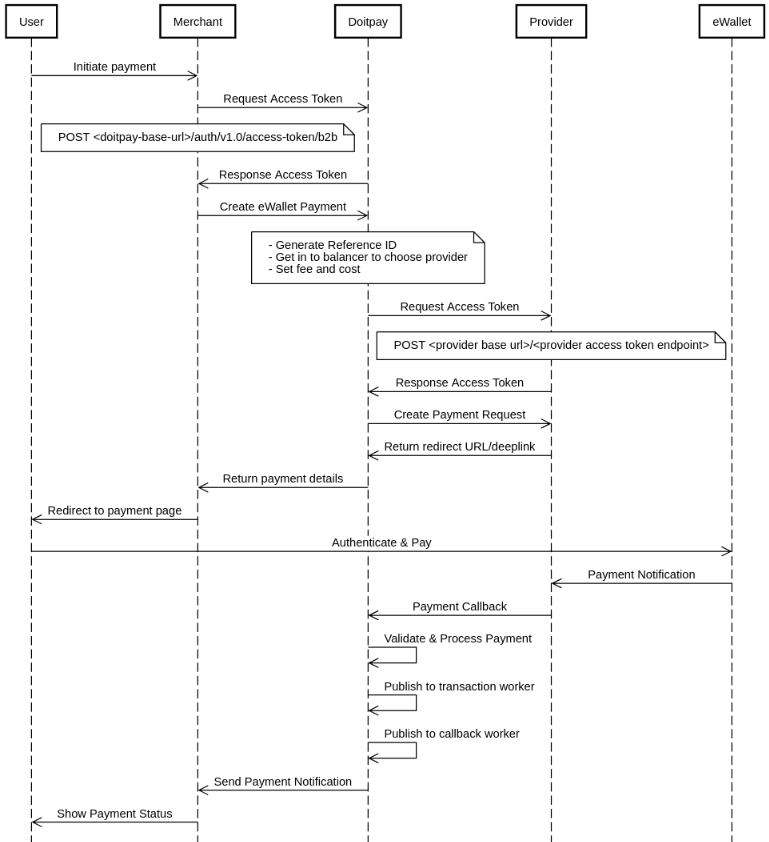
3. Webhook based confirmation strategy
Provider callback path:
- Verify callback authenticity and validate payload integrity
- Enforce idempotency to safely handle duplicates
- Apply strict state transition rules and write final state once
Merchant notification path:
- Publish a webhook event when a transaction reaches a terminal state
- Implement retry with backoff and replay safe delivery
- Provide a status query endpoint as a fallback for merchant initiated checks
Why it mattered: Polling can exhaust resources at scale. A webhook based approach reduces system load while still delivering reliable status convergence.
4. Webhook contract and merchant experience
Webhook events:
- payment.paid
- payment.failed
- payment.expired
Merchant safety:
- Stable identifiers for correlation
- Replay safe behavior for duplicate delivery
- Status query endpoint for merchant initiated checks
Why it mattered: Merchants can depend on a predictable contract.
5. Observability and evidence readiness
To support troubleshooting and audit evidence, I aligned on an evidence contract for each transition.
Identifiers captured on every transition:
- order_id
- txn_id
- provider_ref
Operational signals:
- Alerts for PENDING payments older than a threshold
- Callback verification failures and mismatch detection
- Dashboard level searchability by txn_id and provider_ref
Results
- Improved reliability by ensuring status convergence through verified provider callbacks and reliable webhook delivery.
- Reduced duplicate processing risk through idempotent updates keyed by provider references.
- Improved merchant integration quality with a consistent redirect and jumpapp flow and clear terminal states.
What I would improve next
1. Stronger state transition evidence by design
- Emit a structured event record for every status change
- Capture the reason and source of truth, such as callback receipt and verification outcome
2. Better merchant debugging experience
- Provide a timeline view per transaction showing key checkpoints
- Include webhook delivery attempts and final delivery status
3. Automated reconciliation coverage
- Add periodic reconciliation for edge cases where provider and internal status diverge
- Keep manual intervention for true exceptions only
4. Webhook operations hardening
- Add webhook delivery observability, including delivery attempts, latency, and error rates
- Support merchant endpoint health checks and clear guidance for retry safe processing